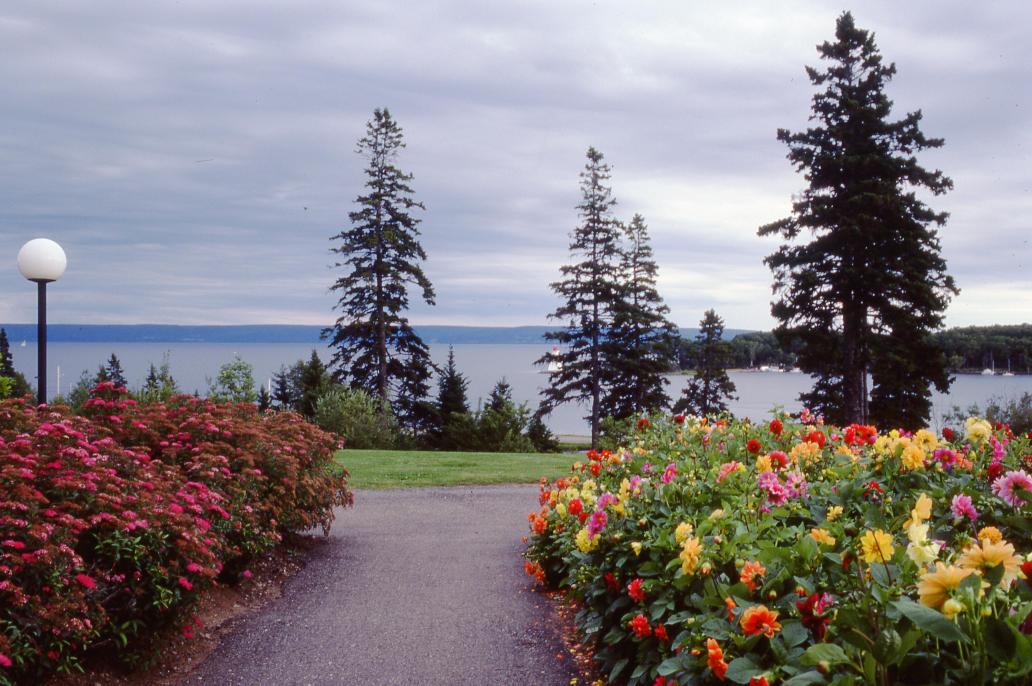
I had advertised on the bulletin board for riders but got no queries. End of season, I supposed. And not many people wanted to go back to Quebec. P and J announced that they were leaving Halifax. After some quick thinking, I decided to check out too. There wasn't much to see in Halifax and what there was I reckoned I could do in a day.
I decided to change some US currency at a bank and immediately ran into a problem. They wouldn't take $100 bills because they were worried about forgeries. I tried a few banks without any luck. Bummer! I really hated Nova Scotia now. I wondered what to do. Well I had enough money to last for a couple of days but I would have to pay for petrol with a credit card. I could get a cash advance on plastic if necessary. But the idea of the money sitting in my pocket useless was infuriating.
I decided to at least see the Grand Pre Historic Park. This is where the Arcadians built up an agricultural district on marshland using dykes and drainage before they were expelled by the British for not taking an oath of loyalty to the crown. They were just farmers who wanted no part of politics but as usual, little people get caught in between.
It was a dreary day. Wentworth hostel is not far from Halifax so I was in no hurry. I took the coastal road to try to see the Bay of Fundy, which has one of the largest tidal variations in the world. The bay faces north south and the funnel amplifies the incoming tides. I saw some coastal marshland which smelt bad and showed signs of large tidal variations, but I guess I was there at the wrong time of day.
Driving in dreary weather was tiring. It was the sort of day when you think the world will end with a whimper instead of a bang. All around nothing is happening, and you don't really care even if anything did.
The hostel handbook said that there was a grocery store on the main road, or at least I infered that. There, I must have just passed it. I went on for another couple of km, just to see if I could spot the town but there wasn't one. Wentworth was simply this slightly denser group of houses. I got bread, milk, mashed potatoes and luncheon meat at the grocery store. The hostel was up on a little hill. There were several cars and some children playing. Pretty crowded for the end of season I thought. There were indications that the hostel was used as a ski lodge in winter, like the notice about boots. Eventually it turned out that the people were biologists, on a specimen collecting trip. They were from museums from all over. I was the only other hosteller. It was a boring night. I used up the last aerogram and curled up with a book.
It was not so far to Halifax. How to kill the time until 5 in the afternoon? I decided on a slow drive along the south coast. There is this Marine Drive that goes south to the coast and then west to Halifax.
 Unfortunately I didn't notice that there was a ferry along the way. This turned out to be a ferry pulled by a cable running from bank to bank. The fee was only a measly 50 cents, but they ran only every half hour.
I was near the head of the boat. It was a slow day. A hearse drove on. Interesting to be sharing a ferry with a loaded hearse. The crossing only took five minutes, but upon reaching the other shore, the hearse was in no hurry to drive off. Well, its other occupant was in no hurry I'm sure.
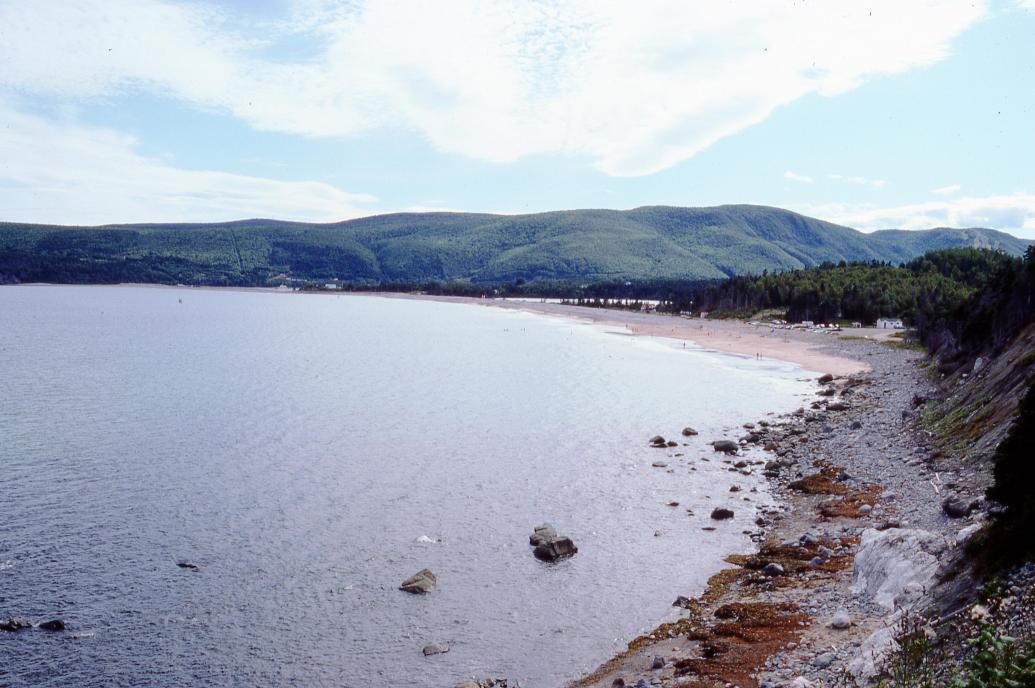
There is much beautiful coastal scenery here—coves, inlets and little nooks that you would expect from a highly indented coastline.
I stopped at a seafood restaurant for lunch. I missed having lobster in PEI because I didn't have anybody to go with. I felt like I deserved some seafood. This place got good marks in somebody's travel guide. I ordered a lobster chowder and finished up with pastry. Lunch was delicious.
Halifax
was larger than I expected. Did you have visions of a smelly fishing
town? Halifax was a modern city, complete with skyscrapers. The harbour
reminded me of Hobart. I arrived around evening rush hour but
fortunately didn't have to contend with too much traffic. The hostel
seemed to be in a depressed area of town. Well the maritime provinces were economically depressed, but the cracks showed more in the city. Lots
of unemployed hanging around the shelter.
Unfortunately I didn't notice that there was a ferry along the way. This turned out to be a ferry pulled by a cable running from bank to bank. The fee was only a measly 50 cents, but they ran only every half hour.
I was near the head of the boat. It was a slow day. A hearse drove on. Interesting to be sharing a ferry with a loaded hearse. The crossing only took five minutes, but upon reaching the other shore, the hearse was in no hurry to drive off. Well, its other occupant was in no hurry I'm sure.
There is much beautiful coastal scenery here—coves, inlets and little nooks that you would expect from a highly indented coastline.
I stopped at a seafood restaurant for lunch. I missed having lobster in PEI because I didn't have anybody to go with. I felt like I deserved some seafood. This place got good marks in somebody's travel guide. I ordered a lobster chowder and finished up with pastry. Lunch was delicious.
Halifax
was larger than I expected. Did you have visions of a smelly fishing
town? Halifax was a modern city, complete with skyscrapers. The harbour
reminded me of Hobart. I arrived around evening rush hour but
fortunately didn't have to contend with too much traffic. The hostel
seemed to be in a depressed area of town. Well the maritime provinces were economically depressed, but the cracks showed more in the city. Lots
of unemployed hanging around the shelter.

I had an hour to kill so I parked the car in the yard and walked downtown. I found a Radio Shack store and
replaced the old batteries in the camera. Since it was a warm day and I
felt fatigued, I treated myself to a root beer at the A&W. They
didn't seem to make those foot long hot dogs anymore. Pity. Every fast food
chain seemed to have gone for burgers in some form, or chicken nuggets.
When I checked in the house parent asked me if I came by car. She gave me a
$2 rebate so that I could park at the covered garage downtown, 10 minutes
walk away. I explored a little of downtown before walking back. The old town was interesting, but as luck would have it, I didn't have my camera with me. For tomorrow then. Trust Murphy to give me good scenery when I was not prepared.
P and J from PEI were at the hostel too. They were at Seal Island but didn't like the unheated facility and went to a motel. I didn't have much food except the haddock filet which by this time was smelly. I decided to drown the fish in chicken soup. There was a good collection of free food in the kitchen and I had bread and butter as well. I was very tempted, back there in town, to go for the $1.50 dinner advertised outside a pub.
I suggested going out for a beer. They were a little concerned about the safety of the area, but by American standards, the area was benign. I was tired and gave up the idea, so we three ended up playing ping-pong in the hostel. There was a laundry in the basement but lots of people were in line and everytime I came back to check, somebody had gone ahead of me. I got my stuff washed and dried by midnight. There was a shower in the basement too, so I used that to avoid making noise upstairs.
The day started slowly but turned out to be the high point of my trip. Unfortunately my camera batteries gave out and I had to use manual setting. Fortunately I knew how to estimate exposure but I had to do some guessing for pictures taken in deep shade.
The Cabot Trail is reputed to be the most magnificent drive in North America. I could do clockwise or counter-clockwise. For no particular reason, I decided to go clockwise. This meant backtracking to Baddeck.
I passed a sign that said Crab Meat For Sale. Sure, why not? It was a house that sold food from the kitchen. The nice lady sold me a pound of crab legs for a dollar and a half, cold from the fridge.
I took them to a nearby overlook and ate them in view of the magnificent ocean. Best lunch I had on the trip.
The great scenery starts when you enter the National Park. The trail runs along the sea, combining views of land, sky and water.
Dotting the trail are information signs and entrances to walking trails. All these were noted in the guides I obtained at the visitor centre near the entrance. I didn't have time for even a medium length trail, but I found a few short ones.
One view pointed out 3 kinds of rocks in the scene, igneous, metamorphic and sedimentary. Another, Lone Shieling, explained maple and other trees. A lone shieling is a crofter's shelter in Scotland. The land was donated by a descendant in memory of the old country. Very educational. Well done, Parks Canada.
The Cabot trail is one that many cyclists dream of conquering someday. It is about 300 km long. I saw several brave souls along the way. Not easy, the ups are gruelling but the downs must be exhilarating!
After a whole day of superlative scenery, I found myself still within the National Park at about 4 in the afternoon. Many of the coves and inlets reminded me of Scotland, which of course is the origin of the province's name.
Up Kelly's Hill again, and at about 6 I was driving past North Sydney (NS). There was no time for Louisbourg, a historic and doomed French settlement from the early 1700s.
I drove along the east bank of the Bras d'Or towards the Canso Causeway as dusk was falling, an ideal time. I was sad to leave this lovely part of NS but I had to head for Antigonish because the nearest hostel was there.
I found the hostel in the dark, it was a trailer court and the dorm was a converted barn. I met the motorcyclist from Seal Island hostel again. Stop following me around, he joked. For dinner I gave in and went to a fast food outlet because there were no kitchen facilities. I was too tired anyway. At least there was a good hot shower, even if it was coin operated.
A German girl staying in the hostel was doing a bit of travelling on her way back home from Vancouver where she had been a nanny. There was a cute kitten on the grounds. She and I played with it for a while.
It was a dreary day to leave PEI, but there was no reason to stay. The Aussie couple caught a ride with me to Nova Scotia. M, the Canadian girl was getting off near Highway 3 because she was going to Souris to catch the ferry to Iles de la Madelaine to take a plane back to Montreal. B decided at the last moment to catch a ride with me to NS. So they all piled into my car. It would only be cramped until M got off.
The ferry ride was longer than from Cape Tormentine to Borden, but I disliked doubling back so I felt it was worth the extra time and cost. The ride was unremarkable and weather even more dreary by the time we reached the mainland. Close to lunchtime, I left the Aussies on the main highway to Halifax, near a diner. They gave me their address in Australia, in case I was ever in that part of the world again. B got off near the Canso Causeway.
Once I reached the causeway, the scenery got more interesting. Northern NS is Cape Breton Island, joined to the mainland by a 2 km causeway. What's more the island has a partial salt lake, the Bras d'Or, running through the centre. This as you may imagine, makes the scenery magnificent.
I was trying to reach the Seal Island hostel before dark. It was no problem, but first there was a diversion, the Alexander Graham Bell national historic site.
The museum is in Baddeck and really interesting. Bell tinkered with many things besides telephones. It was an age when inventors didn't work for big corporations.
Near Baddeck I picked up an interesting hitch hiker, carrying a briefcase. He was a worker from near North Sydney (NS) who had been down in Halifax for a medical checkup. He told me how much he liked the Canadian welfare system. I later found out how concentrated the population of NS is in and around Halifax. Only about 10 towns in NS have a population of over 10,000.
The Seal Island hostel was actually a camp ground with one building set aside for hostellers. There was no heating. I made dinner from the rest of my provisions and some that I bought from the camp store. When you shop for oneself, invariably the portions are too large and you eat the same thing (haddock, in my case) for a couple of days. I still had the haddock when I reached Halifax and it was about to really go bad then so I made a stew of it.
Just before the hostel was a low hill about 300 metres high. The overview of the Bras d'Or was magnificent. It was also the most beautiful hour of the day, dusk. By nightfall, a motorcyclist I had met in Campbelton arrived too. I had a magnificent view of the stars. The Milky Way could be plainly seen. Unfortunately I did not have a star map handy and it was cold so I crawled into my sleeping bag and dozed off.
I still hadn't visited Charlottetown so I headed downtown, parked the car and strolled around.
Charlottetown had a pleasant provincial feel, a place where life proceeds at an unhurried pace.
I also visited a nearby market that morning.
The marina at Charlottetown.
Even so, Charlottetown was small enough that I was finished touring by lunch and had an afternoon in hand.
Looking at the map and the list of events, I noticed there was an Arcadian festival going on near Abrams-Village. They were demonstrating traditional skills such as woodchopping and horse team pull.
There was a small crafts shop (artisanat) near the fairgrounds. They had some interesting objects. An old quilt came with the story that one day the artist saw a plane for the first time in the sky. It made such an impression on her that she recorded her feelings with quiltwork.
Because the original Arcadians were a small group of families, a few names predominate. It seemed like every second family was called Arsenault, for example.
Nearby Cape Egmont afforded a fantastic view of PEI cliffs, these ones facing the mainland.
It took a bit of work to find the gravel road to the lookout.
After dinner, at the hostel, the German girl claimed that she knew Chinese numbers. She showed us various arrangements of matchsticks and named the corresponding numbers. It was an old trick. One by one people catch on that the presenter is just making it up and pretend to agree with the numbers called out. The last person is the butt of the joke.
Part of the reason why my Aussie friends wanted to drive out to the countryside was to see Green Gables. I'd never heard of Anne of the Green Gables or Lucy Maud Montgomery and apparently I've missed out on a childhood treasure, similar to being ignorant of Winnie the Pooh.
Green Gables is a restored house where Lucy's cousins lived. The character of Anne and her surroundings are based upon the author's childhood visits to this farm.
There is a serene, wooded walk on the grounds where Lucy drew inspiration for her novels' setting.
The Anne series of novels has given impetus to the development of the tourism in PEI. It seems that the novels are very popular in translation in Japan. Sort of fits in with the Japanese penchant for fictional characters that stand out (Anne was a redhead, Pippi Longstocking was another). Sociologists can have a field day comparing this with the conformist nature of their society.
PEI can be divided into 3 regions and we were in the middle. We took the Blue Heron Drive. The red soil is a remarkable feature of PEI landscape. It's due to iron oxides.
To the north near Cavendish is a national park, set up to protect the dunes that protect PEI's soil from being blown away.
It was very windy but the jagged coastline was very scenic.
Fort Amherst historic site tells the story of the struggle between the French and the English in the early 1700's.
The poor Arcadian farmers got caught in between the two warring powers and their subsequent expulsion became a cause célèbre. American poet Longfellow based his epic poem Evangeline on this historical event.
Some Arcadians settled in Louisiana and became Cajuns but many later sneaked back or were allowed back into the maritime provinces.
Arcadians have been separated from France for so long that their language retains features that have died out in standard French.


 Unfortunately I didn't notice that there was a ferry along the way. This turned out to be a ferry pulled by a cable running from bank to bank. The fee was only a measly 50 cents, but they ran only every half hour.